
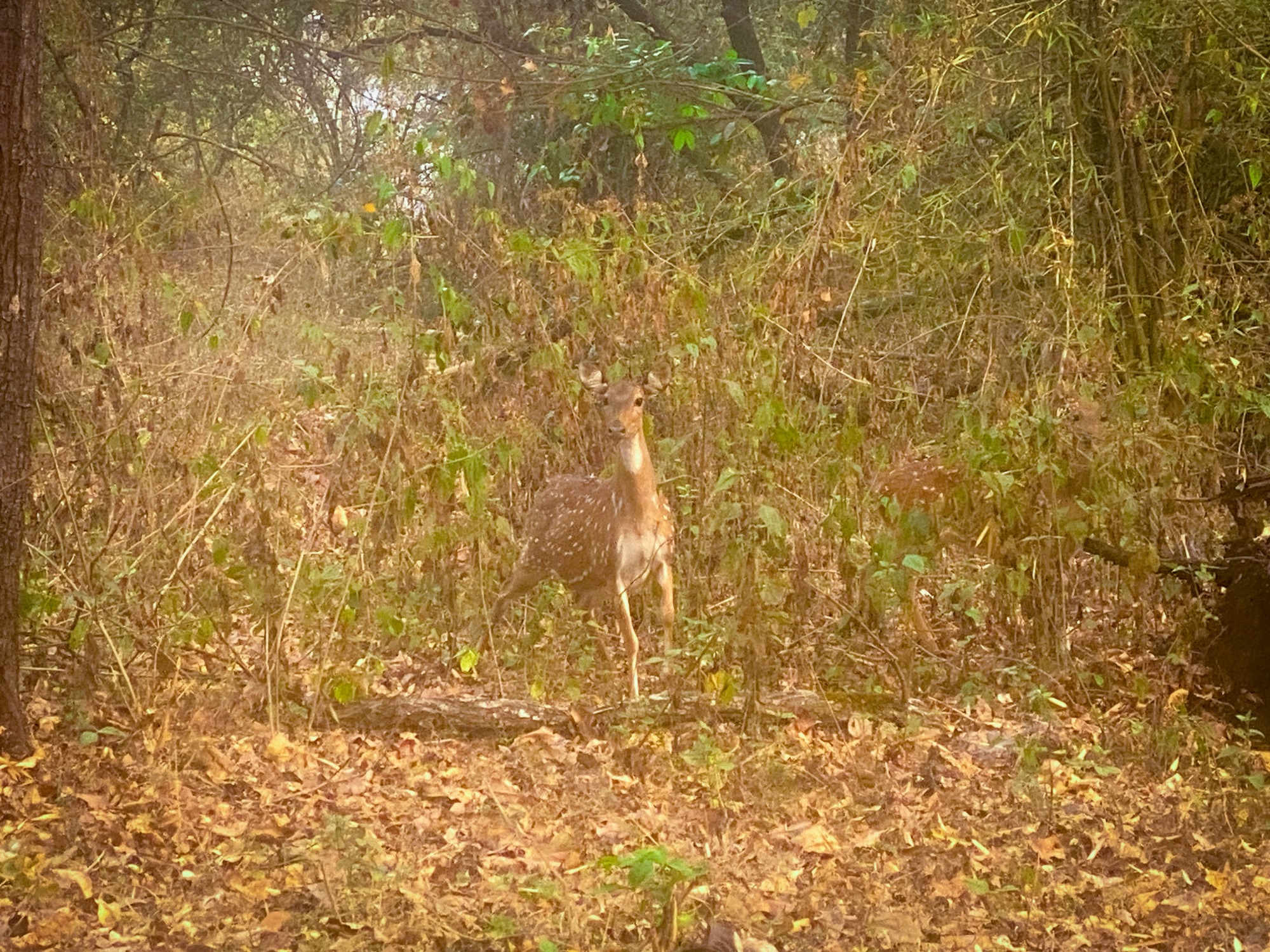
Something is pushing the big cats out of Bhadra and it has been for a long time.
It was early morning when the CCTV footage had caught it. A black leopard scouting the lodge area at the Bhadra Tiger Reserve. It had been scanning the perimeter before scurrying away a few minutes later. A few of the locals had noticed it too.
I was there around the end of February. The reserve sits in Karnataka’s Chikkamagaluru district, cradled by the Western Ghats, and it has long been one of India’s conservation successes. It was declared a Project Tiger Reserve in 1998 and is notable as the first tiger reserve in the country to complete a successful village relocation program, resettling 26 villages by 2002. Today, the reserve hosts over 30 tigers and 20 leopards.
Leopards in particular have long been documented operating at the margins of human settlements. They coexist within tiger territory by focusing on smaller prey, and their habit of lifting kills into trees is a survival strategy that they have evolved into.
Experts at Down to Earth have noted that the frequent sightings of leopards in Karnataka are less a sign that their population is thriving and more of a sign their habitat is shrinking. When leopards are seen in places they wouldn’t typically inhabit, it’s because the places they would inhabit are gone or compromised.
The black leopard at Bhadra is a rare sight to witness. Camera trap studies by the Centre for Wildlife Studies have documented photo-capture events of melanistic leopards at Bhadra going back to at least 2009, and the long-term monitoring project has covered Karnataka’s Malenad-Mysore Tiger Landscape for over two decades.
Black leopards have now been documented in all five tiger reserves of Karnataka: Nagarahole, Bandipur, Bhadra, BRT, and Kali. Bhadra’s moist deciduous forests and rugged ridgelines make it ideal habitat for the melanistic form, where dark colouring offers a camouflage advantage.
A former chief conservation officer of Bardiya National Park in Nepal, describing a nearly identical phenomenon, put it directly: “As tigers claim the prime habitat, leopards are forced out. They initially survived on stray dogs in the villages, but once that food source was exhausted, they turned to livestock. Now, with livestock secured behind fences, humans have become the next available target.”
Tigers too are moving. Tigers are solitary and territorial; with rising populations, territories compress and overlap. Dominant males drive out the weaker, who then move into buffer zones or stray into human landscapes entirely. Long-term monitoring has even documented record dispersals: one tiger designated BDT-130 dispersed from Bhadra all the way to Dandeli in May of 2008, covering nearly 200 kilometres.
Between 2021 and 2025, 239 people died in wildlife attacks across Karnataka. The loss of forest habitat and fragmentation has resulted in elephants and tigers straying into human settlements, producing what officials describe as an “acute conflict situation.”
In late 2025, the situation reached a political threshold. Karnataka Chief Minister Siddaramaiah stated publicly that increased human intervention in wildlife areas is causing tigers and leopards to move closer to human settlements. He cites shortages of water and fodder inside the forests as direct drivers. He directed officials to scientifically analyse why animals are straying away and to find long-term solutions for said issue.
The Forest Survey of India identified six forested regions along the Western Ghats in Karnataka and Kerala as climate change hotspots. Then, recording temperature rises of more than 1.5°C alongside rainfall changes of 20 per cent or more in recent decades. Bhadra also sits within this band of disruption.

The effects on the forest are cascading. Erratic rainfall patterns have impacted food production in forests, which is crucial for wildlife as well as communities. In some parts, 2023 brought drought-like conditions, causing a massive shortage of water for household use and agriculture. Climate change is altering the distribution of flora and fauna in the Western Ghats, with invasive species spreading rapidly and wildlife increasingly venturing into human settlements.
Water scarcity is a direct trigger for this phenomenon. Driven by thirst, animals such as leopards, elephants, and foxes venture into human settlements in search of water. The Bhadra Dam, where people have been spotting the black leopard, is a permanent water source. As water sources dry up inside the reserve, animals gather around the Bhadra River and its reservoirs.
The IUCN has placed the Western Ghats in a category of “significant concern” in its World Heritage Outlook report, flagging climate change, infrastructure development, tourism, and invasive species as major stressors.
Karnataka’s situation contains a paradox that conservation globally has struggled to resolve. In 1972, Bandipur Tiger Reserve had 12 tigers. By 2025, there were 175. That is an approx. fourteen-fold increase in fifty years. But, the forest didn’t grow fourteen-fold.
India now has over 3,167 tigers in the wild according to the fifth Tiger Census. The intensity and frequency of human-animal conflict and associated deaths have been increasing every year, even as the conservation success story is celebrated.
The black leopard scouting the lodge perimeter at Bhadra is the embodiment of this contradiction. The reserve is healthy enough to sustain a breeding melanistic leopard population. Just weeks before my visit, a wildlife photographer at the Bhadra backwaters captured footage of a black panther and a spotted leopard drinking side by side, which was a sighting so extraordinary that it went viral globally.
Sanjay Gubbi, a leopard expert, has been blunt about what this means: Karnataka has approximately 2,500 leopards, of which roughly 11 percent are melanistic. Although their population is thriving, the space around them is clearly not.
The government’s response so far reads like a list of necessary but insufficient measures. Barricades along forest fringes. A leopard task force. A command centre. Waterholes to be refilled. Lantana to be cleared. Consultations with environmentalists planned to address development concerns while prioritising human safety.
The final question to ask, is what will happen now?
The author visited the Bhadra Tiger Reserve area in late February 2026. The CCTV footage and dam sightings referenced in this piece are drawn from staff and local eyewitness accounts gathered on the ground. For verification and sourcing, contact the editorial desk.

Leave a Reply